Showing posts with label Bread. Show all posts

Thursday, March 17, 2011

Irish Soda Bread

Despite a significant amount of Irish in my blood, I'd never had Irish soda bread until last weekend. With Saint Patrick's Day upon us, I've seen requests for this recipe everywhere, and it piqued my interest. When I first saw the (very simple) ingredient list, I thought, "What is so special about this bread?"

CRW_0108c

It seemed easy enough to whip up, so that I did. My first loaf was dense and almost chewy - not good eats. This recipe turned out so much better for my second attempt, and had me singing the praises of Irish soda bread along with everyone else.

This tasty bread is crisp on the outside, but so soft on the inside. The buttermilk lends great flavor to the bread - tear off a piece and enjoy with butter, jam, or just by itself! Happy Saint Patrick's Day!

Irish Soda Bread


Irish Soda Bread
Source: Slightly adapted from Cate's World Kitchen
Yield: 1 loaf
Preparation time: 10 minutes
Cook time: 45 minutes
Total time: 55 minutes

Ingredients

  • 2 1/2 cups whole wheat pastry flour
  • 1 teaspoon salt
  • 1 1/8 teaspoons baking soda (fresh is best)
  • 1 1/4 cups buttermilk

Instructions

  1. Preheat the oven to 350 F, and grease a baking sheet (or line with parchment)
  2. Combine the flour, salt and baking soda in a medium bowl and wisk together with a fork.
  3. Stir in half the buttermilk, then add the remaining buttermilk 2 tbsp at a time.
  4. You want the dough to be just a little bit moist. It should hold together, but not be sticky. If you accidentally add too much milk, knead in some flour until the dough is no longer sticky.
  5. Shape into a ball, then cut an X into the top.
  6. Bake for about 45 minutes, or until golden brown. (If you tap on the bottom of the loaf with your knuckles, it should sound hollow).
  7. Let cool as long as you can stand to wait, then serve with butter and jam.
    Best if eaten within about 3 hours of baking.


    Wednesday, January 13, 2010

    Roasted Tomatillo Enchiladas

    IMG_0015c

    Enchiladas is usually a dish my husband prepares, as he learned from his mother. I saw this recipe at Mary Ellen's Cooking Creations and figured I'd give him a treat, and make the enchiladas myself.  I've become somewhat obsessed with tomatillos lately, so I couldn't wait to try this take on enchiladas.  I made some modifications to the filling, using avocado to keep the chicken from drying out, and it worked great! I also decided to go with homemade whole wheat tortillas, which turned out to be really easy to make, and delicious!  The enchiladas were absolutely fantastic, and perfect when topped with fresh pico de gallo!

    IMG_0011c
    IMG_0016c

    Roasted Tomatillo Enchiladas
    Source: Slightly adapted from Mary Ellen's Cooking Creations

    For the chicken: 
    • about 1 pound boneless, skinless chicken breasts
    • 3 tablespoons olive oil
    • 2 cloves garlic, chopped
    • 1 jalapeno, chopped
    • 1/3 bunch of cilantro,
    • 1 tbsp chili powder
    • 1/2 tbsp cumin (we use coriander)
    • 1 tsp Mexican oregano
    • 1/4 tsp cayenne pepper
    • 2 tbsp lime juice - added about an hour before cooking
    For the enchiladas:
    • 4-5 strips roasted red pepper (from jar), diced
    • 1 avocado, peeled and fruit diced
    • 1/4 cup shredded Mexican blend cheese, plus more cheese for topping the enchiladas
    • Creamy Roasted Tomatillo Sauce (recipe follows)
    • 7-8 corn or flour tortillas, warmed (recipe follows)
    Directions:
    1. Combine chicken with marinade ingredients (except lime juice) in a large ziplock bag or bowl. Refrigerate at least 4 hours, adding the lime juice during the last hour.  After removing the chicken from the marinade, saute it until golden brown on all sides. Shred the chicken, or chop it up into rough cubes.
    2. In a bowl, combine cooked chicken, red pepper, avocado, and 1/4 cup Mexican blend cheese. 
    3. Coat the bottom of a baking dish with some of the tomatillo sauce.
    4. Take a tortilla shell, dip both sides in the tomatilla sauce, then add some of the chicken mixture.  Roll it and put into the baking dish, seam side down.
    5. Continue until you have filled the casserole dish, making sure the enchiladas are tightly packed together (but not overlapping).
    6. Spoon the tomatillo sauce over the enchiladas, and finish with a sprinkling of shredded cheese.
    7. Cover and bake on 375 for about 25 minutes, or until hot and bubbly.

    Creamy Roasted Tomatillo Sauce
    • 10 small/medium tomatillos; remove husks and wash; cut into halves or quarters
    • 2 jalapenos, roughly chopped
    • 1 onion, roughly chopped
    • 3 cloves garlic, roughly chopped
    • Olive oil
    • Salt
    • 1 cup cilantro, thoroughly washed
    • 1/2 cup 2% cottage cheese, blended thoroughly
    • 3 oz Monterrey Jack cheese
    • Dash of salt
    Directions
    • Combine the first 5 ingredients in a baking dish. Roast on 450 degrees for about 20 minutes, or until tomatillos are tender.
    • In a pot, add roasted veggies, cilantro, and the salt. Mix everything together and then puree. I used my handheld immersion blender, but if you don't have one you could use a blender.
    • Add the cottage cheese and stir thoroughly. 
    • Add the cheese and stir until melted.
    • Let lightly simmer until you are ready to assemble your enchiladas, stirring occasionally.

    Homemade Whole Wheat Flour Tortillas
    Source: Slightly adapted from The Homesick Texan/The Border Cookbook by Cheryl Alters Jamison and Bill Jamison
    Makes 8 tortillas
    • Two cups of whole wheat pastry flour
    • 1 1/2 teaspoons of baking powder
    • 1 teaspoon of salt
    • 2 teaspoons of vegetable oil
    • 3/4 cups of warm milk
    1. Mix together the flour, baking powder, salt and oil.  Slowly add the warm milk.  Stir until a loose, sticky ball is formed.  Knead for two minutes on a floured surface. Dough should be firm and soft.  Place dough in a bowl and cover with a damp cloth or plastic wrap for 20 minutes.
    2. After the dough has rested, break off eight sections, roll them into balls in your hands, place on a plate (make sure they aren’t touching) and then cover balls with damp cloth or plastic wrap for 10 minutes. (It’s very important to let the dough rest, otherwise it will be like elastic and won’t roll out to a proper thickness and shape.)
    3. After dough has rested, one at a time place a dough ball on a floured surface, pat it out into a four-inch circle, and then roll with a rolling pin from the center until it’s thin and about eight inches in diameter. (If you roll out pie crusts you’ll have no problem with this.) Don’t over work the dough, or it’ll be stiff. Keep rolled-out tortillas covered until ready to cook.
    4.  In a dry iron skillet or comal heated on high, cook the tortilla about thirty seconds on each side. It should start to puff a bit when it’s done.  Keep cooked tortillas covered wrapped in a napkin until ready to eat.

    Can be reheated in a dry iron skillet, over your gas-burner flame or in the oven wrapped in foil.  While you probably won’t have any leftovers, you can store in the fridge tightly wrapped in foil or plastic for a day or so.

    Wednesday, January 6, 2010

    Squash Burritos

    I was looking for something simple but tasty for a weekend lunch. This recipe sounded great since I had all the ingredients on hand, and it sounded amenable to freezing so we could save some for later. IMG_0025c

    I was pleasantly surprised at how well these flavors complemented each other - they were much better than I anticipated! They ended up being more like tacos or quesadillas because I used homemade tortillas and they turned out a little small, but they were still fabulous.  I ended up using feta since I didn't have goat cheese on hand, and I think either will work just as well. They have worked out well in the freezer, too, though it may be best to freeze the filling itself, then add to a fresh tortilla when you are ready to eat.

    Squash Burritos
    Source: Everyday Food
    • 1 tablespoon vegetable oil, such as safflower
    • 1 medium onion, finely chopped
    • 2 garlic cloves, minced
    • 1 teaspoon ground cumin (I use coriander)
    • 1 package (10 ounces) frozen cooked winter squash, thawed
    • 2 cans (15 ounces each) black beans, rinsed and drained
    • 1 package (10 ounces) frozen leaf spinach, thawed and squeezed dry
    • Coarse salt and ground pepper
    • 4 flour tortillas (10-inch) (recipe follows)
    • 5 ounces fresh goat cheese, crumbled
    • 1/2 cup store-bought salsa, plus more for serving

    1. In a large skillet, heat oil over medium. Add onion, garlic, and cumin; cook, stirring occasionally, until onion is tender, 5 to 6 minutes.
    2. Add squash, and cook, stirring occasionally, until mixture is slightly thickened, 2 to 3 minutes. Stir in beans and spinach. Cook until warmed through, 4 to 6 minutes; season with salt and pepper, and set aside.
    3. Stack tortillas, and wrap in a double layer of damp paper towels; microwave until hot, about 2 minutes. Place tortillas on a work surface. Spoon goat cheese, then salsa in a line down center of each tortilla.
    4. Spoon bean mixture on top of salsa. Fold side of tortilla closest to you over filling, then fold right and left sides in toward center; tightly roll up burrito. Cut burritos in half, and serve with more salsa.

    Homemade Whole Wheat Flour Tortillas
    Source: Slightly adapted from The Homesick Texan/The Border Cookbook by Cheryl Alters Jamison and Bill Jamison
    Makes 8 tortillas
    • Two cups of whole wheat pastry flour
    • 1 1/2 teaspoons of baking powder
    • 1 teaspoon of salt
    • 2 teaspoons of vegetable oil
    • 3/4 cups of warm milk
    1. Mix together the flour, baking powder, salt and oil.  Slowly add the warm milk.  Stir until a loose, sticky ball is formed.  Knead for two minutes on a floured surface. Dough should be firm and soft.  Place dough in a bowl and cover with a damp cloth or plastic wrap for 20 minutes.
    2. After the dough has rested, break off eight (or four, to make larger tortillas) sections, roll them into balls in your hands, place on a plate (make sure they aren’t touching) and then cover balls with damp cloth or plastic wrap for 10 minutes. (It’s very important to let the dough rest, otherwise it will be like elastic and won’t roll out to a proper thickness and shape.)
    3. After dough has rested, one at a time place a dough ball on a floured surface, pat it out into a four-inch circle, and then roll with a rolling pin from the center until it’s thin and about eight inches in diameter. (If you roll out pie crusts you’ll have no problem with this.) Don’t over work the dough, or it’ll be stiff. Keep rolled-out tortillas covered until ready to cook.
    4.  In a dry iron skillet or comal heated on high, cook the tortilla about thirty seconds on each side. It should start to puff a bit when it’s done.  Keep cooked tortillas covered wrapped in a napkin until ready to eat.

    Can be reheated in a dry iron skillet, over your gas-burner flame or in the oven wrapped in foil.  While you probably won’t have any leftovers, you can store in the fridge tightly wrapped in foil or plastic for a day or so.

    Monday, January 4, 2010

    Cranberry Pecan Bagels

    IMG_0021.400

    I am still 100% in love with whole wheat bagels, and this time around I wanted to try a new flavor combination. With numerous bags of cranberries tucked away in my freezer, this was a good way to use some of them! I found that the perfect compliment to the cranberry pecan flavor was to top them with a cinnamon honey cream cheese - delicious!

    Cranberry Pecan Bagels
    Source: Slightly adapted from Whole Grain Breads, by Peter Reinhart

    Day 1: Make the soaker and biga
    Soaker:
    1 3/4 cups (227 grams) whole wheat flour
    1/2 teaspoon (4 grams) salt
    1/2 cup plus 2 tablespoons (142 grams) water
    2 tablespoons (35.5 grams) barley malt syrup, dark or light (for most authentic flavor), or honey

    Mix all ingredients together in a bowl for about one minute, until all of the flour is hydrated and the ingredients form a ball of dough. Cover loosely with plastic wrap and leave at room temp for 12 to 24 hours. (If you need more time, place in refrigerator for up to 3 days, but leave at room temp 2 hours before continuing with bread).

    Biga:
    1 3/4 cups (227 grams) whole wheat flour
    1/4 teaspoon (1 gram) instant yeast
    1/2 cup plus 2 tablespoons (142 grams) filtered or spring water, at room temperature (about 70 degrees F)

    Mix all the biga ingredients together in a bowl to form a ball of dough. With wet hands, knead dough in the bowl for 2 minutes to be sure all ingredients are evenly distributed and the flour is fully hydrated. The dough should be tacky. Let the dough rest for 5 minutes, then knead again with wet hands for one minute. The dough will be smoother but still tacky. Transfer to a clean bowl, cover tightly with plastic wrap, and refrigerate for at least 8 hours and up to 3 days. Remove from the fridge two hours before making the dough.

    Day 2: Make the final dough, and bake
    Final Dough:
    All of the Soaker
    All of the biga
    5/8 teaspoon (5 grams) salt
    2 1/4 teaspoons (7 grams) instant yeast
    2 tablespoons (28.5 grams) water, at room temperature (about 70 degrees F)
    7 tablespoons (56.5 grams) whole wheat flour
    3/4 cup chopped fresh (or frozen) cranberries
    1/4 cup chopped pecans
    2 teaspoons baking soda


    1. Chop the soaker and biga into 12 smaller pieces (sprinkle flour over pieces to prevent sticking).

    2. By hand: Dissolve yeast in water in mixing bowl, then add biga, soaker, and salt and stir vigorously with a mixing spoon or knead with wet hands for about 3-4 minutes, until all ingredients are evenly integrated. Add the flour and knead for 2 more minutes, the dough should be firm but not sticky. If not, add more flour or water as needed.

    By stand mixer: Dissolve yeast in water in mixing bowl, then add biga, soaker, and salt and mix on low speed for one minute with hook. Add flour, cranberries, and pecans and mix on medium-low speed for 3-4 minutes until dough becomes cohesive and assimilated into each other. Add more flour or water as needed until the dough is firm and not sticky. This is a stiff dough, so turn the mixer off if necessary to avoid stressing the motor.

    3. Dust a work surface with flour, the roll the dough in flour to coat. Knead by hand for 3 to 4 minutes, incorporating only as much flour as needed to form a stiff dough that is supple enough to shape. Form the dough into a ball and let it rest on the work surface for 5 minutes while you prepare a clean, lightly oiled bowl.

    4. Resume kneading for 1 minutes to strengthen the gluten and make any final water/flour adjustments. Dough should have the strength to pass the windowpane test, yet feel supple and satiny. Form dough into a ball and place in prepared bowl, rolling to coat with oil. Cover loosely with plastic wrap and let rise at room temperature for approximately 45 to 60 minutes, until it is about 1.5 times its original size. Meanwhile, prepare a baking sheet with parchment or silicon mat dusted with whole wheat flour or cornmeal.

    5. Transfer to lightly floured work surface and divide into 6 or 7 four ounce pieces (I managed to get 8). Roll each piece into an 8 inch rope, shape a circle around your hand. Sela tight at the point where the ends overlap by squeezing or pressing it into the counter. There should be a 2-inch diameter hole in the center. Place on prepared pan, cover loosely with a towel, leave at room temperature.

    6. Preheat the oven to 500 degrees F. Prepare a baking sheet with parchment (dusted with cooking spray) or silicon mat. Bring 4 inches of water to a boil in a wide pot, add the baking soda to the boiling water. Lower the head to maintain a steady simmer.

    7. The bagels should be read to boil within 20-30 minutes of shaping . Drop one in the boiling water, if it doesn't float within 30 seconds, boil it until it floats and then remove it, but wait 5 minutes before testing another. When they pass the test, boil 2-4 bagels at a time, gently turning them after 30 seconds so they boil for a total of one minute. Use a slotted spoon or skimmer to remove them from the water and transfer to prepared baking sheet. Apply toppings, using an egg wash to help them stick, if necessary.

    8. Place the baking sheet in the oven and reduce to 450 degrees F. Bake for 15 minutes, then rotate sheet and bake 10 to 15 minutes more until bagels are nicely browned on top and bottom. Remove and cool on cooling rack for 20 minutes before serving.

    Friday, December 4, 2009

    Pumpkin Spice Bagels

    In this house, we have been obsessed with whole wheat bagels since I first made them in August. I've finally figured out a plan, so I only have to make them once a month. I made two double batches - one cheddar jalapeno for my husband, and usually sesame for me - and we are able to (stuff our freezer and) stretch this for four weeks. Last time I decided to make a seasonal bagel for myself instead of the sesame, and of course, pumpkin was the first thing that came to mind. I really wasn't sure whether it would be better to add the pumpkin to the biga, the soaker, or at the end in the final dough. I decided on final dough, with a slight adjustment in flour at that step since the pumpkin made the dough quite wet. Overall, they were a huge success! I was hoping for a nice swirl from the cinnamon, but it eluded me this time. Swirl or not, they are delicious, and the pumpkin and cinnamon are a subtle but welcome addition to these hearty bagels.
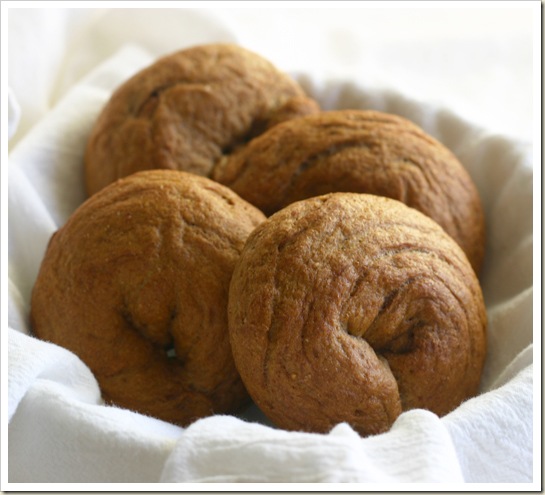
    IMG_0015c

    Pumpkin Spice Whole Wheat Bagels
    Source: Adapted from Whole Grain Breads, Peter Reinhart

    Day 1: Make the soaker and biga
    Soaker:
    1 3/4 cups (227 grams) whole wheat flour
    1/2 teaspoon (4 grams) salt
    1/2 cup plus 2 tablespoons (142 grams) water
    2 tablespoons (35.5 grams) barley malt syrup, dark or light (for most authentic flavor), or honey

    Mix all ingredients together in a bowl for about one minute, until all of the flour is hydrated and the ingredients form a ball of dough. Cover loosely with plastic wrap and leave at room temp for 12 to 24 hours. (If you need more time, place in refrigerator for up to 3 days, but leave at room temp 2 hours before continuing with bread).

    Biga:
    1 3/4 cups (227 grams) whole wheat flour
    1/4 teaspoon (1 gram) instant yeast
    1/2 cup plus 2 tablespoons (142 grams) filtered or spring water, at room temperature (about 70 degrees F)

    Mix all the biga ingredients together in a bowl to form a ball of dough. With wet hands, knead dough in the bowl for 2 minutes to be sure all ingredients are evenly distributed and the flour is fully hydrated. The dough should be tacky. Let the dough rest for 5 minutes, then knead again with wet hands for one minute. The dough will be smoother but still tacky. Transfer to a clean bowl, cover tightly with plastic wrap, and refrigerate for at least 8 hours and up to 3 days. Remove from the fridge two hours before making the dough.

    Day 2: Make the final dough, and bake

    Final Dough:
    All of the Soaker
    All of the biga
    5/8 teaspoon (5 grams) salt
    2 1/4 teaspoons (7 grams) instant yeast
    2 tablespoons (28.5 grams) water, at room temperature (about 70 degrees F)
    1 cup pumpkin puree
    3/4 cup plus 1 tablespoon (106.5 grams) whole wheat flour
    2 teaspoons baking soda
    4 teaspoons ground cinnamon
    4 teaspoons sucanat (or brown sugar)

    1. Chop the soaker and biga into 12 smaller pieces (sprinkle flour over pieces to prevent sticking).

    2. By hand: Dissolve yeast in water in mixing bowl, then add biga, soaker, and salt and stir vigorously with a mixing spoon or knead with wet hands for about 3-4 minutes, until all ingredients are evenly integrated. Add the pumpkin and flour and knead for 2 more minutes, the dough should be firm but not sticky. If not, add more flour or water as needed.

    By stand mixer: Dissolve yeast in water in mixing bowl, then add biga, soaker, and salt and mix on low speed for one minute with hook. Add pumpkin and flour and mix on medium-low speed for 3-4 minutes until dough becomes cohesive and assimilated into each other. Add more flour or water as needed until the dough is firm and not sticky. This is a stiff dough, so turn the mixer off if necessary to avoid stressing the motor.

    3. Dust a work surface with flour, the roll the dough in flour to coat. Knead by hand for 3 to 4 minutes, incorporating only as much flour as needed to form a stiff dough that is supple enough to shape. Form the dough into a ball and let it rest on the work surface for 5 minutes while you prepare a clean, lightly oiled bowl.

    4. Resume kneading for 1 minutes to strengthen the gluten and make any final water/flour adjustments. Dough should have the strength to pass the windowpane test, yet feel supple and satiny. Form dough into a ball and place in prepared bowl, rolling to coat with oil. Cover loosely with plastic wrap and let rise at room temperature for approximately 45 to 60 minutes, until it is about 1.5 times its original size. Meanwhile, prepare a baking sheet with parchment or silicon mat dusted with whole wheat flour or cornmeal.

    5. Transfer to lightly floured work surface and divide into 6 or 7 four ounce pieces (I managed to get 8). In a small bowl, combine sucanat and cinnamon.  Stretch out each piece of dough to approximately 7"x2".  Sprinkle with about 1/2 teaspoon of cinnamon/sugar mixture.  Starting at one end, roll up each piece of dough.  Then, roll each piece into an 8 inch rope, shape a circle around your hand. Seal tight at the point where the ends overlap by squeezing or pressing it into the counter. There should be a 2-inch diameter hole in the center. Place on prepared pan, cover loosely with a towel, leave at room temperature.
    IMG_0002c

    IMG_0004c
    6. Preheat the oven to 500 degrees F. Prepare a baking sheet with parchment (dusted with cooking spray) or silicon mat. Bring 4 inches of water to a boil in a wide pot, add the baking soda to the boiling water. Lower the head to maintain a steady simmer.

    7. The bagels should be read to boil within 20-30 minutes of shaping . Drop one in the boiling water, if it doesn't float within 30 seconds, boil it until it floats and then remove it, but wait 5 minutes before testing another. When they pass the test, boil 2-4 bagels at a time, gently turning them after 30 seconds so they boil for a total of one minute. Use a slotted spoon or skimmer to remove them from the water and transfer to prepared baking sheet. Apply toppings, using an egg wash to help them stick, if necessary.

    8. Place the baking sheet in the oven and reduce to 450 degrees F. Bake for 15 minutes, then rotate sheet and bake 10 to 15 minutes more until bagels are nicely browned on top and bottom. Remove and cool on cooling rack for 20 minutes before serving.

    Wednesday, December 2, 2009

    Bulgur Dinner Rolls

    I had to laugh when my friend Katie pointed me in the direction of this recipe.  I immediately identified with the blogger, as I also suffer from CDUWG!  (That is, Compulsive Disorder of Using Whole Grains).  A few months ago, I thought I was cool for using brown rice instead of white rice.  Now my pantry is overflowing with whole wheat couscous, bulgur, quinoa... and I can't wait to discover and try out new whole grains. 

    IMG_0003c
    This recipe instantly drew me in.  The dinner rolls looked gorgeous and sounded perfect for Thanksgiving dinner.  Except, of course, that the recipe calls for all purpose flour.  Certainly, it has it's place, but I hate making "whole wheat" bread with 50% white flour.  Seems... silly, to me.  So, I poked Bridget, a fellow Reinhart/Whole Grain Breads follower, and asked for help figuring out how to adapt this to a whole wheat recipe.  See, I can bake right along with a recipe, for the most part (I see you, the elusive scone that I can't make without destroying). When it comes to translating technique from one recipe to another, I get lost.  I get scared.  I don't really take defeat in the kitchen very well, so I don't take too many chances.  I took Bridget's suggestion of combining the flour, milk, and some salt to make a soaker (as in the other recipes I've made from Reinhart).  Making the dough the next day was tricky, as it was way too wet. I didn't panic :-) and just added some more flour until it was no longer sticky.
    IMG_0007c 
    The final product was beyond delicious.  I used fresh thyme instead of rosemary, since that's what I had.  The nutty whole wheat-y-ness was wonderful, even though I think I under-baked them a tad.  My husband and I fell in love with these dinner rolls, and they will certainly grace the table at Christmas.

    Bulgur Dinner Rolls
    Source: Adapted from Chef In You

    Day 1: Prepare the soaker
    • 1 cup milk
    • 1 tsp salt
    • 3 cups whole wheat flour
    Mix all ingredients together in a bowl for about one minute, until all of the flour is hydrated and the ingredients form a ball of dough. Cover loosely with plastic wrap and leave at room temp for 12 to 24 hours. (If you need more time, place in refrigerator for up to 3 days, but leave at room temp 2 hours before continuing with bread).

    Day 2: Make the rolls
    • 1/2 cup bulgur (bulghur or burghul)
    • 1 cup boiling water
    • 1 envelope active dry yeast
    • 1/4 cup lukewarm water (about 110 degrees F)
    • 2 tbsp fresh herbs (rosemary, thyme, etc)
    • 4 tbsp vegetable oil
    • 2 tbsp honey
    • 3/4 cup whole wheat flour
    1. Place the cracked wheat (bulgur) into a bowl and pour out the boiling water over it. Cover and soak it for an hour until it has absorbed all the water.

    2. Sprinkle the yeast over the warm water in a large bowl (or bowl of stand mixer) and stir to dissolve.  Chop the soaker into 12 smaller pieces (sprinkle flour over pieces to prevent sticking).

    3. By hand: add soaker and all the remaining ingredients to the yeast and stir vigorously with a mixing spoon or knead with wet hands for about 2 minutes, until all ingredients are evenly integrated. Dough should be soft and slightly sticky, if not, add more flour or water as needed.

    By stand mixer: add soaker and all the remaining ingredients to the yeast and mix on low speed for one minute with paddle (preferred) or hook. Switch to hook and mix on medium-low speed for 2-3 minutes until dough becomes cohesive and assimilated into each other. Add more flour or water as needed until the dough is soft and slightly sticky.

    4. Dust a work surface with flour, the roll the dough in flour to coat. Knead by hand for 1 to 2 minutes, incorporating only as much flour as needed, until the dough feels soft and tacky, but not sticky. Form the dough into a ball and let it rest on the work surface for 5 minutes while you prepare a clean, lightly oiled bowl.

    5. Resume kneading for 1 minutes to strengthen the gluten and make any final water/flour adjustments. Dough should be soft and supple. Form dough into a ball and place in prepared bowl, rolling to coat with oil. Cover loosely with plastic wrap and let rise at room temperature for approximately 45 to 60 minutes, until it is about 1.5 times its original size.

    6. Transfer to lightly floured work surface. Divide into 10 pieces and roll into a round shape.  Place on sheet pan lined with parchment paper. Cover loosely with plastic wrap or a cloth towel. Let rise at room temperature for approximately 45 minutes, until it is about 1.5 times its original size.

    7. Preheat the oven to 400 degrees F.  Bake for15-20 minutes, until the edges turn a light brown.

    Wednesday, October 28, 2009

    Cinnamon Raisin Bread


    This is another gem from Peter Reinhart's Whole Grain Breads.  I don't know how many ways I can express my love for this book, and the recipes therein, but this one has me singing its praises again!  I was pleasantly surprised by how much I loved the chopped walnuts and pecans (I did a mix of both) worked into the dough.  They add a nice bite to an other wise soft dough. I could see after the fact that I should have used every last bit of the cinnamon/sugar mixture in the swirl, as mine is not terribly pronounced.

    IMG_0018c

    I think it ended up being a bit too cold in my house, and the bread didn't rise well after rolling into shape.  I got impatient and just baked it anyway, but I think it would have looked a lot nicer had I let it rise appropriately.  I could also see, after the fact, that I should have used every last bit of the cinnamon/sugar mixture in the swirl, as mine is not terribly pronounced.  Any way you slice it, it tastes fantastic and I can't wait to make it again!

    Cinnamon Raisin Bread
    Source: Rewritten/Slightly adapted from Whole Grain Breads, by Peter Reinhart
    Yield: 1 loaf

    Day 1:
    Soaker:

    170 grams whole wheat flour
    3/8 teaspoon (3 grams) salt
    170 grams milk or yogurt
    170 grams raisins

    Mix all ingredients except raisins together in a bowl for about one minute, until all of the flour is hydrated and the ingredients form a ball of dough. Add raisins and knead with wet hands until incorporated.  Cover loosely with plastic wrap and leave at room temp for 12 to 24 hours. (If you need more time, place in refrigerator for up to 3 days, but leave at room temp 2 hours before continuing with bread).

    Biga:
    170 grams whole wheat flour
    1/4 teaspoon (1 gram) instant yeast
    85 grams milk or yogurt, at room temperature (about 70 degrees F)
    56.5 grams melted butter or vegetable oil
    1 egg (47 grams), slightly beaten

    Mix all the biga ingredients together in a bowl to form a ball of dough. With wet hands, knead dough in the bowl for 2 minutes to be sure all ingredients are evenly distributed and the flour is fully hydrated. The dough should be tacky. Let the dough rest for 5 minutes, then knead again with wet hands for one minute. The dough will be smoother but still tacky. Transfer to a clean bowl, cover tightly with plastic wrap, and refrigerate for at least 8 hours and up to 3 days.

    Day 2:
    Remove the biga from the fridge two hours before making the dough.

    Final Dough:
    All of the Soaker
    All of the biga
    7 tablespoons (56.5 grams) whole wheat flour
    5/8 teaspoon (5 grams) salt
    2 1/4 teaspoons (7 grams) instant yeast
    28.5 grams honey or agave nectar
    1/2 teaspoon (4 grams) plus 2 teaspoons ground cinnamon, divided
    85 grams chopped pecans or walnuts
    3 Tablespoons sugar or sucanat


    1. Chop the soaker and biga into 12 smaller pieces (sprinkle flour over pieces to prevent sticking).

    2. By hand: combine biga and soaker into a large bowl with flour through honey, plus 1/2 teaspoon cinnamon.  Stir vigorously with a mixing spoon or knead with wet hands for about 2 minutes, until all ingredients are evenly integrated. Dough should be soft and slightly sticky, if not, add more flour or water as needed.

    By stand mixer: combine biga and soaker with flour through honey, plus 1/2 teaspoon cinnamon into mixer bowl and mix on low speed for one minute with paddle (preferred) or hook. Switch to hook and mix on medium-low speed for 2-3 minutes until dough becomes cohesive and assimilated into each other. Add more flour or water as needed until the dough is soft and slightly sticky.

    3. Dust a work surface with flour, the roll the dough in flour to coat. Sprinkle nuts on dough and knead by hand for 3 to 4 minutes, incorporating only as much flour as needed, until the dough feels soft and tacky, but not sticky. Form the dough into a ball and let it rest on the work surface for 5 minutes while you prepare a clean, lightly oiled bowl.

    4. Resume kneading for 1 minutes to strengthen the gluten and make any final water/flour adjustments. Dough should have the strength to pass the windowpane test, but still be soft, supple, and very tacky. Form dough into a ball and place in prepared bowl, rolling to coat with oil. Cover loosely with plastic wrap and let rise at room temperature for approximately 45 to 60 minutes, until it is about 1.5 times its original size.

    5. Dust work surface with 1 tablespoon of flour.  Transfer dough to work surface without tearing.  Roll into 8"x8" square that is 1/2" thick.  Mix 2 teaspoons cinnamon with 3 tablespoons sugar or sucanat and sprinkle mixture evenly on dough.  Roll dough into a tight loaf.  Place in a greased 4 1/2"x9" pan.  Mist the top of the loaf with cooking spray, then cover loosely with plastic wrap and let rise at room temperature for 45-60 minutes, until it is about 1.5 times its original size.

    6. Preheat the oven to 400 degrees F.  Reduce the temperature to 325 degrees F, remove plastic wrap and place pan in oven on middle rack.  Bake for 20 minutes, then rotate the pan and continue baking 25 to 40 minutes more, until bread is golden brown on all sides and a thermometer inserted registers at least 195 degrees F. Remove from the oven and cool on a rack for at least one hour before serving.

    Friday, September 11, 2009

    Sandwich Bread turned Burger Buns

    I scoured my rental copy of Peter Reinhart's Whole Grain Breads for a recipe for burger buns. There were none to be found. I decided a decent substitute would be either the sandwich bread, shaped into rolls, or the pita bread recipe. I polled my husband and he voted sandwich bread, so off I went!


    By now I am getting very familiar with this 2 day pre-dough process. The sandwich bread, in contrast to the bagel and hearth bread, has a lot more moisture to the dough (which I'm sure my stand mixer is thanking me for). But other than that, the process is pretty much the same, and goes quite easily for me. Since I can't, for the life of me, make pie dough or scones, I have to be good at something, right?


    The rolls are slightly sweet (I go by weight measure and sometimes wonder if weight and measure don't really add up for the agave nectar), and soft and spongy. I'm pretty sure they took the artichoke turkey burger to the next level - we couldn't get enough!


    Sandwich Bread / Burger Buns
    Source: Rewritten Whole Wheat Sandwich bread from Whole Grain Breads, Peter Reinhart
    Yield: 11 rolls (3 oz each)

    Day 1:
    Soaker:

    1 3/4 cups (227 grams) whole wheat flour
    1/2 teaspoon (4 grams) salt
    3/4 cup plus 2 tablespoons (198 grams) milk, buttermilk, yogurt, soy milk, or rice milk

    Mix all ingredients together in a bowl for about one minute, until all of the flour is hydrated and the ingredients form a ball of dough. Cover loosely with plastic wrap and leave at room temp for 12 to 24 hours. (If you need more time, place in refrigerator for up to 3 days, but leave at room temp 2 hours before continuing with bread).

    Biga:
    1 3/4 cups (227 grams) whole wheat flour
    1/4 teaspoon (1 gram) instant yeast
    3/4 cup (170 grams) filtered or spring water, at room temperature (about 70 degrees F)

    Mix all the biga ingredients together in a bowl to form a ball of dough. With wet hands, knead dough in the bowl for 2 minutes to be sure all ingredients are evenly distributed and the flour is fully hydrated. The dough should be tacky. Let the dough rest for 5 minutes, then knead again with wet hands for one minute. The dough will be smoother but still tacky. Transfer to a clean bowl, cover tightly with plastic wrap, and refrigerate for at least 8 hours and up to 3 days.

    Day 2:
    Remove the biga from the fridge two hours before making the dough.

    Final Dough:
    All of the Soaker
    All of the biga
    7 tablespoons (56.5 grams) whole wheat flour
    5/8 teaspoon (5 grams) salt
    2 1/4 teaspoons (7 grams) instant yeast
    2 1/4 tablespoons (42.5 grams) honey or agave nectar (optional)
    1 tablespoon (14 grams) unsalted butter, melted, or vegetable oil

    1. Chop the soaker and biga into 12 smaller pieces (sprinkle flour over pieces to prevent sticking).

    2. By hand: combine biga and soaker into a large bowl with all the remaining ingredients and stir vigorously with a mixing spoon or knead with wet hands for about 2 minutes, until all ingredients are evenly integrated. Dough should be soft and slightly sticky, if not, add more flour or water as needed.

    By stand mixer: combine biga and soaker with all the remaining ingredients into mixer bowl and mix on low speed for one minute with paddle (preferred) or hook. Switch to hook and mix on medium-low speed for 2-3 minutes until dough becomes cohesive and assimilated into each other. Add more flour or water as needed until the dough is soft and slightly sticky.

    3. Dust a work surface with flour, the roll the dough in flour to coat. Knead by hand for 3 to 4 minutes, incorporating only as much flour as needed, until the dough feels soft and tacky, but not sticky. Form the dough into a ball and let it rest on the work surface for 5 minutes while you prepare a clean, lightly oiled bowl.

    4. Resume kneading for 1 minutes to strengthen the gluten and make any final water/flour adjustments. Dough should have the strength to pass the windowpane test, but still be soft, supple, and very tacky. Form dough into a ball and place in prepared bowl, rolling to coat with oil. Cover loosely with plastic wrap and let rise at room temperature for approximately 45 to 60 minutes, until it is about 1.5 times its original size.

    5. Transfer to lightly floured work surface. Form into either a loaf pan or into 3 ounce rounds for burger buns. For loaf pan bread, place dough in a greased 4 by 8.5 inch bread pan. For buns, place on sheet pan lined with parchment paper. Mist the top with pan spray (optional) and cover loosely with plastic wrap or a cloth towel. Let rise at room temperature for approximately 45 minutes, until it is about 1.5 times its original size.

    6. Preheat the oven to 425 degrees F. When the dough is ready to bake, place it in the oven and turn down the oven to 350 degrees F. Bake for 20 minutes. Rotate the bread and continue baking 20 to 30 minutes more, until bread is a rich brown. or until a thermometer inserted registers at least 195 degrees F. Remove from the oven and cool on a rack for at least one hour before serving.

    Nutritional Information
    Per serving (3 ounce buns)

    Calories: 174
    Total Fat: 2 g
    Sat Fat: 0.8 g
    Carb: 35 g
    Fiber: 6 g
    Sugar: 1.2 g
    Protein: 6.8 g
    Sodium: 344 mg
    Cholesterol: 3 mg

    Tuesday, August 25, 2009

    Whole Wheat Bagels


    Oh, I'm in love! This is another whole wheat bread recipe from Peter Reinhart's book, and they are absolutely fabulous. I was getting tired of english muffins with my breakfast, so I couldn't wait to try making bagels. My only complaint is that the recipe only makes 6 to 7 bagels (I got 8). Between my husband and myself, we'll polish those off before the week is out! These involve a very similar pre-dough process to the whole wheat hearth bread recipe, but I think the bagels are fantastic and worth the wait! If you want to avoid the white flour in traditional bagel recipes, definitely give these a try!

    My breakfast:

    1 sesame bagel
    + 1 egg lightly beaten and microwaved for about 1 minute
    + 1 chicken sausage patty=


    Whole Wheat Bagels
    Source: Rewritten from Whole Grain Breads, Peter Reinhart

    Day 1: Make the soaker and biga
    Soaker:
    1 3/4 cups (227 grams) whole wheat flour
    1/2 teaspoon (4 grams) salt
    1/2 cup plus 2 tablespoons (142 grams) water
    2 tablespoons (35.5 grams) barley malt syrup, dark or light (for most authentic flavor), or honey

    Mix all ingredients together in a bowl for about one minute, until all of the flour is hydrated and the ingredients form a ball of dough. Cover loosely with plastic wrap and leave at room temp for 12 to 24 hours. (If you need more time, place in refrigerator for up to 3 days, but leave at room temp 2 hours before continuing with bread).

    Biga:
    1 3/4 cups (227 grams) whole wheat flour
    1/4 teaspoon (1 gram) instant yeast
    1/2 cup plus 2 tablespoons (142 grams) filtered or spring water, at room temperature (about 70 degrees F)

    Mix all the biga ingredients together in a bowl to form a ball of dough. With wet hands, knead dough in the bowl for 2 minutes to be sure all ingredients are evenly distributed and the flour is fully hydrated. The dough should be tacky. Let the dough rest for 5 minutes, then knead again with wet hands for one minute. The dough will be smoother but still tacky. Transfer to a clean bowl, cover tightly with plastic wrap, and refrigerate for at least 8 hours and up to 3 days. Remove from the fridge two hours before making the dough.

    Day 2: Make the final dough, and bake

    Final Dough:
    All of the Soaker
    All of the biga
    5/8 teaspoon (5 grams) salt
    2 1/4 teaspoons (7 grams) instant yeast
    2 tablespoons (28.5 grams) water, at room temperature (about 70 degrees F)
    7 tablespoons (56.5 grams) whole wheat flour
    bagel toppings
    2 teaspoons baking soda
    beaten egg white for toppings (optional)

    1. Chop the soaker and biga into 12 smaller pieces (sprinkle flour over pieces to prevent sticking).

    2. By hand: Dissolve yeast in water in mixing bowl, then add biga, soaker, and salt and stir vigorously with a mixing spoon or knead with wet hands for about 3-4 minutes, until all ingredients are evenly integrated. Add the flour and knead for 2 more minutes, the dough should be firm but not sticky. If not, add more flour or water as needed.

    By stand mixer: Dissolve yeast in water in mixing bowl, then add biga, soaker, and salt and mix on low speed for one minute with hook. Add flour and mix on medium-low speed for 3-4 minutes until dough becomes cohesive and assimilated into each other. Add more flour or water as needed until the dough is firm and not sticky. This is a stiff dough, so turn the mixer off if necessary to avoid stressing the motor.

    3. Dust a work surface with flour, the roll the dough in flour to coat. Knead by hand for 3 to 4 minutes, incorporating only as much flour as needed to form a stiff dough that is supple enough to shape. Form the dough into a ball and let it rest on the work surface for 5 minutes while you prepare a clean, lightly oiled bowl.

    4. Resume kneading for 1 minutes to strengthen the gluten and make any final water/flour adjustments. Dough should have the strength to pass the windowpane test, yet feel supple and satiny. Form dough into a ball and place in prepared bowl, rolling to coat with oil. Cover loosely with plastic wrap and let rise at room temperature for approximately 45 to 60 minutes, until it is about 1.5 times its original size. Meanwhile, prepare a baking sheet with parchment or silicon mat dusted with whole wheat flour or cornmeal.

    5. Transfer to lightly floured work surface and divide into 6 or 7 four ounce pieces (I managed to get 8). Roll each piece into an 8 inch rope, shape a circle around your hand. Sela tight at the point where the ends overlap by squeezing or pressing it into the counter. There should be a 2-inch diameter hole in the center. Place on prepared pan, cover loosely with a towel, leave at room temperature.

    6. Preheat the oven to 500 degrees F. Prepare a baking sheet with parchment (dusted with cooking spray) or silicon mat. Bring 4 inches of water to a boil in a wide pot, add the baking soda to the boiling water. Lower the head to maintain a steady simmer.

    7. The bagels should be read to boil within 20-30 minutes of shaping . Drop one in the boiling water, if it doesn't float within 30 seconds, boil it until it floats and then remove it, but wait 5 minutes before testing another. When they pass the test, boil 2-4 bagels at a time, gently turning them after 30 seconds so they boil for a total of one minute. Use a slotted spoon or skimmer to remove them from the water and transfer to prepared baking sheet. Apply toppings, using an egg wash to help them stick, if necessary.

    8. Place the baking sheet in the oven and reduce to 450 degrees F. Bake for 15 minutes, then rotate sheet and bake 10 to 15 minutes more until bagels are nicely browned on top and bottom. Remove and cool on cooling rack for 20 minutes before serving.

    Nutritional Information:
    The book claims these to be 25 calories. This has to be wrong so I will estimate the calories based on the macronutrients.
    Calories: approximately 230.
    Protein: 1.14 g
    Carb: 53.43 g
    Fiber: 8.63 g
    Sugar: 0.28g
    Fat: 1.33 g
    Sat fat: 0.24 g
    Cholesterol: 0 mg
    Sodium: 478 mg

    Monday, August 24, 2009

    Whole Wheat Hearth Bread

    So this was my first time jumping into the bread making pool. I heard that Peter Reinhart had a book out, based solely on whole wheat breads, and immediately looked it up in my library's catalog. They had it so I picked it up that day! In my recent efforts to eat clean, I am staying away from white breads (not that I haven't anyway for last few years) and this book provides me with a plethora of homemade whole wheat bread options.

    This is one serious bread making book, and these recipes are involved. I see a lot of recipes that are... dump all ingredients together, rise, shape (and perhaps rise some more), bake. This is a little different. There are pre-doughs to be made, overnight waits, regular dough to be made, rising, shaping, more rising, then baking! Definitely a very involved process, but I couldn't wait to get started!

    I began with the whole wheat hearth bread because we were having sweet potato gnocchi and that seemed like the best thing to go with it. I added some agave nectar, but still think it could be more tender. There is certainly some room for improvement in my technique, but I think I'll go with the butter too, next time.


    Whole Wheat Hearth Bread
    Source: Rewritten from Whole Grain Breads, Peter Reinhart

    Soaker:
    1 3/4 cups (227 grams) whole wheat flour
    1/2 teaspoon (4 grams) salt
    3/4 cup (170 grams) water

    Mix all ingredients together in a bowl for about one minute, until all of the flour is hydrated and the ingredients form a ball of dough. Cover loosely with plastic wrap and leave at room temp for 12 to 24 hours. (If you need more time, place in refrigerator for up to 3 days, but leave at room temp 2 hours before continuing with bread).

    Biga:
    1 3/4 cups (227 grams) whole wheat flour
    1/4 teaspoon (1 gram) instant yeast
    3/4 cup (170 grams) water

    Mix all the biga ingredients together in a bowl to form a ball of dough. With wet hands, knead dough in the bowl for 2 minutes to be sure all ingredients are evenly distributed and the flour is fully hydrated. The dough should be tacky. Let the dough rest for 5 minutes, then knead again with wet hands for one minute. The dough will be smoother but still tacky. Transfer to a clean bowl, cover tightly with plastic wrap, and refrigerate for at least 8 hours and up to 3 days. Remove from the fridge two hours before making the dough.

    Final Dough:
    All of the Soaker
    All of the biga
    3 1/2 tablespoons (28.5 grams) whole wheat flour
    5/8 teaspoon (5 grams) salt
    2 1/4 teaspoons (7 grams) instant yeast
    2 1/4 teaspoons (14 grams) honey or agave nectar (optional)
    1 tablespoon (14 grams) unsalted butter, melted, or vegetable oil, or olive oil (optional)

    1. Chop the soaker and biga into 12 smaller pieces (sprinkle flour over pieces to prevent sticking).

    2. By hand: combine biga and soaker into a large bowl with all the remaining ingredients and stir vigorously with a mixing spoon or knead with wet hands for about 2 minutes, until all ingredients are evenly integrated. Dough should be soft and slightly sticky, if not, add more flour or water as needed.

    By stand mixer: combine biga and soaker with all the remaining ingredients into mixer bowl and mix on low speed for one minute with paddle (preferred) or hook. Switch to hook and mix on medium-low speed for 2-3 minutes until dough becomes cohesive and assimilated into each other. Add more flour or water as needed until the dough is soft and slightly sticky.

    3. Dust a work surface with flour, the roll the dough in flour to coat. Knead by hand for 3 to 4 minutes, incorporating only as much flour as needed, until the dough feels soft and tacky, but not sticky. Form the dough into a ball and let it rest on the work surface for 5 minutes while you prepare a clean, lightly oiled bowl.

    4. Resume kneading for 1 minutes to strengthen the gluten and make any final water/flour adjustments. Dough should have the strength to pass the windowpane test, but still be soft, supple, and very tacky. Form dough into a ball and place in prepared bowl, rolling to coat with oil. Cover loosely with plastic wrap and let rise at room temperature for approximately 45 to 60 minutes, until it is about 1.5 times its original size.

    5. Transfer to lightly floured work surface. Form the dough into a boule, 2 to 4 batards or 4 mini baguettes, being careful to degas as little as possible while shaping. Place the boule onto a parchment lined baking sheet and mist the top with pan spray. Cover loosely with plastic wrap or a cloth towel and let rise at room temperature for approximately 45 minutes, until it is about 1.5 times its original size.

    6. Preheat the oven to 500 degrees F with a baking stone inside; prepare for steam baking by placing a walled cookie sheet on the top rack and boiling some water. When the dough is ready to bake, place it in the oven and add 1 cup of hot water to the steam pan. Turn down the oven to 450 degrees F and bake for 20 minutes. Rotate the bread and continue baking 15 to 30 minutes more, until bread is a rich brown on all sides, sounds hollow when thumped on the bottom, and a thermometer inserted registers at least 200 degrees F. Remove from the oven and cool on a rack for at least one hour before serving.

    Nutritional Information
    Per serving (1.5 ounces or 42 grams)

    Calories: 87
    Total Fat: 1 g
    Sat Fat: 0.4 g
    Carb: 17.6 g
    Fiber: 3 g
    Sugar: 0.6 g
    Protein: 3.4 g
    Sodium: 172 mg
    Cholesterol: 1.5 mg

    Slice and enjoy!

    Wednesday, April 1, 2009

    English Muffins

    My new breakfast habit is making my own egg sandwiches in the morning. Now that I have discovered you can cook (cracked) eggs in the microwave, an egg breakfast during the work week became much more feasible. I wanted to see if I could make good english muffins at home, so I had control over the ingredients, size, etc. I found a number of recipes that used shortening, which isn't exactly the (healthier) direction I want to go. Then I stumbled upon a recipe that uses egg whites! I was intrigued and decided it was worth a shot (don't they look good?!). I made some alterations in the flour. It calls for 4 cups of bread flour, but I went with 1 cup bread flour, 1 cup whole wheat flour, and 2 cups whole wheat pastry flour. Since the pastry flour has a lower protein content than the bread flour, I added a little protein powder and wheat germ to make up a little of the difference.


    One of my favorite parts of the english muffin making process was that there is no need to turn on the oven! This will make it easy to continue making them throughout the summer. Due to the additions I made, they had a great hearty, nutty flavor. I think the 3" size is too small, however, so next time I will go with 4" for my sandwiches. I think these would be a great alternative to burger buns for us, as well! (I am realizing just now that I never toasted the muffin! It was still warm from the griddle so I didn't notice!)


    English Muffins
    Source: Cookingbread.com
    Makes 18 3" muffins
    Adaptations in italics

    1 1/4 cups lukewarm water
    1 cup bread flour
    1 cup whole wheat flour
    2 cups whole wheat pastry flour
    2 tablespoons wheat germ
    2 tablespoons vanilla protein powder
    2 1/2 teaspoons instant yeast
    1/2 teaspoon baking soda
    1 1/2 teaspoons salt
    2 small egg whites
    fine cornmeal

    In a large bowl pour in lukewarm ( 110F ) water. Add instant yeast, baking soda and 2 cups of bread flour. Mix till smooth. Allow to sit for 5 minutes uncovered. In the meantime, add egg white into a separate bowl and beat with an electric mixer. You want them to become stiff and moist. Once the egg white have formed stiff peaks; add to dough batter. Using a rubber spatula fold in egg whites till incorporated into the batter. Start to add in the rest of the flour, a 1/4 cup at a time. After the first 1/4 cup mix in salt. When the mixture becomes to hard to mix in the bowl. Pour out onto a flat surface. Knead for about 5 to 6 minutes till it becomes smooth and silky. Add a little oil to a clean bowl and place the dough into the bowl. Turn dough over till all sides are very lightly coated. Cover with plastic wrap and allow to rest till double in bulk, about 1 hour. Afterwards, pour out onto a flat surface. Press to release some of the air from the dough. Using a rolling pin roll out to a 1/2 inch thick. Allow dough to rest for 3 minutes to relax. Using a 3 inch cookie cutter, cut out circles. Place the cut out pieces onto some cornmeal. When you have left over dough just gather together and cut out a few more circles. Sprinkle the tops with more cornmeal. Cover with plastic wrap and allow to rest for 45 minutes. About 5 minutes before you are ready to cook the english muffins turn on your griddle or fry pan to 350F or medium heat. Spray with a little oil spray and once the griddle is hot. Place the muffins on and fry. If you are using a fry pan you may only be able to fry 3-4 at a time. Fry on one side for about 4 minutes. Then turn over and fry for another 4 minutes. Do this once more to a total of 16 minutes.

    Thursday, July 10, 2008

    BB: Jalapeno Cheddar Cornbread


    This week for Barefoot Bloggers, Sabrina and Alexander of Cooking with the Kids chose Jalapeño Cheddar Cornbread. I was so excited to make this because I LOVE cornbread, and my husband loves jalapenos! I found this to be the perfect occasion to make our favorite chili :-)

    I really really enjoyed this cornbread. It was not only great when warm, with the cheddar nicely melted, but also at room temp. You have to love versatility! Since we finally had some cayenne peppers coming off our little pepper plant, I decided to use those instead of jalapeno. I can't wait to make this again!

    Wednesday, June 18, 2008

    Roasted Garlic Hummus and Whole Wheat Pita Bread

    I love hummus, but most recipes call for raw garlic and I find it to be a bit too strong (as much as I love garlic!). I went off in search of a better way to incorporate garlic another way, and came across a recipe for roasted garlic hummus. I made a few modifications and it came out great! This is my go-to hummus recipe now. :-) But, what's hummus without some pita bread? I'm trying to use more whole wheat flour, and found a very simple recipe that was easy and turned out great! I was worried they wouldn't turn out right, as this was my first try at pita bread, but I did achieve the characteristic pocket inside - they even puffed up like whoopee cushions. :-)

    Roasted Garlic Hummus
    Inspired by justinsomnia.org

    ~1 head garlic
    ~1 15-20 oz can chickpeas (garbanzo beans) with liquid reserved
    ~juice of 1 lemon
    ~1/4 cup tahini (sesame paste)
    ~3/4 tsp cayenne pepper
    ~1 1/2 tsp ground coriander
    ~1 tsp freshly ground black pepper
    ~1 1/2 tsp salt
    ~1 tbsp extra virgin olive oil

    Preheat oven to 375F. Cut top off of head of garlic. Spray the tops with olive oil and wrap it in foil. Roast for 45 minutes.

    Discard the shells of the chickpeas. Squeeze roasted garlic out of the skin, and add to a food processor or blender. Add chickpeas and blend. Add the remaining ingredients and blend, using the reserved chickpea liquid to reach the desired consistency.

    Whole Wheat Pita Bread
    Source:Recipezaar.com

    ~4 cups whole wheat flour
    ~1 tablespoon dry yeast ( I used one packet of rapid rise yeast)
    ~1 1/4 cups warm water (120-130F degrees)
    ~1/2 teaspoon salt (optional)

    1. Preheat oven to 500°F.
    2. Sift together 2 cups of flour and the yeast.
    3. Add water and salt and mix well.
    4. Gradually add in the remaining flour just until the dough begins to clean the sides of the bowl. Once this happens, stop adding flour (so, you might not use all the flour the recipe calls for.).
    5. Knead the dough for about 4 or 5 minutes, or until dough is smooth and elastic. (While you're kneading, you can get creative and add in some herbs or spices, but only if you want to do that). Be careful not to over-knead the dough.
    6. Form dough into 10 balls.
    7. On a floured surface, roll each ball into a 5-6 inch circle, about 1/4 inch thick. (Be sure to sprinkle a little flour on both sides to prevent sticking).
    8. Place on a non-stick baking sheet and allow to rise 30 minutes, or until slightly raised.
    9. Just before you place the pan in the oven, flip each pita over on its other side.
    10. Bake on the bottom rack of the oven for 5 minutes. (The instant hot heat will help them puff up).
    11. When the pitas come out of the oven they will be hard, but they will soften as the cool.
    12. Store them, while they're still warm, in plastic baggies or an airtight container.
    13. Cut the pitas in half crosswise and stuff with your favorite fillings (beans and rice, taco fixings, thick stews, curries - anything goes).
    14. Pitas can be reheated in a 350°F oven or in the microwave.

    NOTE: On the second time around, I added about a tablespoon of italian seasoning - wow, what a difference! It really livened them up! I definitely recommend adding your favorite herbs!

    Tuesday, May 27, 2008

    TWD: Pecan Honey Sticky Buns


    This was a LOT easier than I thought it was going to be! I was a little nervous about making the brioche loaf, but I, uh, let the stand mixer do all the hard work. :-) Overall, the worst part about these was waiting so long to get to taste them! They were very yummy, and disappeared quite quickly at work, but in the future I might reduce the amount of honey because I found it to be too much.


    Pecan Honey Sticky Buns
    Source: Baking: From My Home to Yours, by Dorie Greenspan
    Chosen by Madam Chow of Madam Chow’s Kitchen
    See more TWD bakers here!
    Makes 15 buns

    For the Glaze:
    ~1 cup (packed) light brown sugar
    ~1 stick (8 tablespoons) unsalted butter, cut into 4 pieces
    ~1/4 cup honey
    ~1-1/2 cups pecans (whole or pieces)

    For the Filling:
    ~1/4 cup sugar
    ~3 tablespoons (packed) light brown sugar
    ~1 tablespoon ground cinnamon
    ~3 tablespoons unsalted butter, at room temperature

    For the Buns:
    ~1/2 recipe dough for Golden Brioche loaves (see below), chilled and ready to shape (make the full recipe and cut the dough in half after refrigerating it overnight)

    Generously butter a 9-x-13-inch baking pan (a Pyrex pan is perfect for this).

    To make the glaze: In a heavy-bottomed saucepan, bring the brown sugar, butter, and honey to a boil over medium-low heat, stirring frequently to dissolve the sugar. Pour the glaze into the buttered pan, evening it out as best you can by tilting the pan or spreading the glaze with a heatproof spatula. Sprinkle over the pecans.

    To make the filling: Mix the sugars and cinnamon together in a bowl. If necessary, in another bowl, work the butter with a spatula until it is soft, smooth and spreadable.

    To shape the buns: On a flour-dusted work surface, roll the chilled dough into a 16-inch square. Using your fingers or a pastry brush, spread the softened butter over the dough. Sprinkle the dough with the cinnamon sugar, leaving a 1-inch strip bare on the side farthest from you. Starting with the side nearest you, roll the dough into a cylinder, keeping the roll as tight as you can. (At this point, you can wrap the dough airtight and freeze it for up to 2 months . . . . Or, if you want to make just part of the recipe now, you can use as much of the dough as you'd like and freeze the remainder. Reduce the glaze recipe accordingly).

    With a chef's knife, using a gentle sawing motion, trim just a tiny bit from the ends of the roll if they're very ragged or not well filled, then cut the log into 1-inch thick buns. (Because you trim the ragged ends of the dough, and you may have lost a little length in the rolling, you will get 15 buns, not 16.) Fit the buns into the pan cut side down, leaving some space between them.

    Lightly cover the pan with a piece of wax paper and set the pan in a warm place until the buns have doubled in volume, about 1 hour and 45 minutes. The buns are properly risen when they are puffy, soft, doubled and, in all likelihood, touching one another.

    Getting ready to bake: When the buns have almost fully risen , center a rack in the oven and preheat the oven to 375 degrees F.
    Remove the sheet of wax paper and put the pan on a baking sheet lined with parchment or a silicone mat. Bake the sticky buns for about 30 minutes, or until they are puffed and gorgeously golden; the glaze will be bubbling away merrily. Pull the pan from the oven.

    The sticky buns must be unmolded minutes after they come out of the oven. If you do not have a rimmed platter large enough to hold them, use a baking sheet lined with a silicone mate or buttered foil. Be careful - the glaze is super-hot and super-sticky.

    What You'll Need for the Golden Brioche Dough (this recipe makes enough for two brioche loaves. If you divide the dough in half, you would use half for the sticky buns, and you can freeze the other half for a later date, or make a brioche loaf out of it!):

    ~2 packets active dry yeast (each packet of yeast contains approx. 2 1/4 teaspoons)
    ~1/3 cup just-warm-to-the-touch water
    ~1/3 cup just-warm-to-the-touch whole milk
    ~3 1/3 cups all-purpose flour
    ~2 teaspoons salt
    ~3 large eggs, at room temperature
    ~1/4 cup sugar
    ~3 sticks (12 ounces) unsalted butter, at room temperature but still slightly firm.

    To Make The Brioche:
    Put the yeast, water and milk in the bowl of a stand mixer and, using a wooden spoon, stir until the yeast is dissolved. Add the flour and salt, and fit into the mixer with the dough hook, if you have one. Toss a kitchen towel over the mixer, covering the bowl as completely as you can-- this will help keep you, the counter and your kitchen floor from being showered in flour. Turn the mixer on and off a few short pulses, just to dampen the flour (yes, you can peek to see how you're doing), then remove the towel, increase the mixer speed to medium-low and mix for a minute or two, just until the flour is moistened. At this point, you'll have a fairly dry, shaggy mess.

    Scrape the sides and bottom of the bowl with a rubber spatula, set the mixer to low and add the eggs, followed by the sugar. Increase the mixer speed to medium and beat for about 3 minutes, until the dough forms a ball. Reduce the speed to low and add the butter in 2-tablespoon-size chunks, beating until each piece is almost incorporated before adding the next. You'll have a dough that is very soft, almost like batter. Increase the speed to medium-high and continue to beat until the dough pulls away from the sides of the bowl, about 10 minutes.

    Transfer the dough to a clean bowl (or wash out the mixer bowl and use it), cover with plastic wrap and leave at room temperature until nearly doubled in size, 40 to 60 minutes, depending upon the warmth of your room.

    Deflate the dough by lifting it up around the edges and letting it fall with a slap to the bowl. Cover the bowl with the plastic wrap and put it in the refrigerator. Slap the dough down in the bowl every 30 minutes until it stops rising, about 2 hours, then leave the uncovered dough in the refrigerator to chill overnight. (After this, you can proceed with the recipe to make the brioche loaves, or make the sticky buns instead, or freeze all or part of the dough for later use.)

    Saturday, September 1, 2007

    Pineapple Banana Bread

    My fiance eats a lot of bananas, so I try to keep a constant rotating supply in the house. Some weeks, he just doesn't eat them all, and I take that as an excuse to bake. The last few times, I've scoured out some pretty yummy non-banana-bread recipes. This week, I decided to stick with traditional banana bread. Then that can of crushed pineapple in the pantry started calling my name....

    Pre-heat oven to 350 degrees. Beat egg. Add sugar, butter, applesauce, bananas, and pineapple, beat on medium until well-blended. Sift together flour, baking sode, salt, cinnamon, and nutmeg, then slowly add to the banana mixture. Beat on low until well-blended, but be sure not to overbeat. Grease and flour (or use Pam for Baking spray, or parchement paper) a loaf pan and pour in mixture. The original recipe calls for baking 50-60 minutes. I divided this batter into 4 mini loaf pans, so I watched them and checked with toothpicks until done, which was about 40 minutes.

    Pineapple Banana Bread

    (Original Banana Bread recipe from http://thecookingfiend.blogspot.com/)
    • 1 egg
    • 1 cup sugar
    • 3 small or 2 large bananas, very ripe, mashed
    • 1/4 cup butter, melted
    • 1/2 cup applesauce (I used unsweetened)
    • 2 cups flour
    • 1 tsp baking soda
    • 1/4 tsp salt
    • 1/2 tsp cinnamon
    • 1/4 tsp nutmeg
    • 1 (8 oz) can crushed pineapple, drained
    • 1/2 cup chopped walnuts

    Pre-heat oven to 350 degrees. Beat egg. Add sugar, butter, applesauce, bananas, and pineapple, beat on medium until well-blended. Sift together flour, baking sode, salt, cinnamon, and nutmeg, then slowly add to the banana mixture. Beat on low until well-blended, but be sure not to overbeat. Add nuts and mix until evenly distributed. Grease and flour (or use Pam for Baking spray, or parchement paper) a loaf pan and pour in mixture. The original recipe calls for baking 50-60 minutes. I divided this batter into 4 mini loaf pans, so I watched them and check with toothpicks until done, which was about 40 minutes.

    They aren't terribly "pineapple-y", but very moist! The pineapple acts to balance out the banana flavor a bit, without imparting too much distinct pineapple flavor.